What If You Have a Problem With the Tax Department?
Know How to Raise a Grievance
Imagine this.
You have filed your income tax return correctly. You have responded to the notice you received. You have submitted the required documents.
But the problem still isn’t getting resolved.
Or perhaps the issue is not your tax liability at all. You feel that you have been treated unfairly or inappropriately during your interaction with the tax department.
What can you do?
Many taxpayers don’t know that they have formal channels through which they can raise such concerns.
As India’s tax administration becomes increasingly digital and faceless, understanding these grievance mechanisms is becoming just as important as knowing how to file your ITR.
First, Understand What a “Grievance” Means
A grievance is essentially a formal complaint about a problem you are facing with a government service or process.
The Income Tax Department provides an online grievance facility through its e-Filing portal.
It can be used for several issues related to:
- Income tax return processing
- Refunds
- Incorrect demands
- Rectification
- TDS-related matters
- PAN-related issues
- E-Filing and technical problems
- Certain administrative issues
The idea is simple:
Instead of repeatedly following up through emails or office visits, you have a formal channel to record your problem and track its progress.
But What If the Problem Is the Way You Were Treated?
This is where taxpayers need to be particularly careful.
A tax dispute and a conduct complaint are not the same thing.
For example, if you believe that an assessment order is legally incorrect, that is generally a tax dispute and may require an appeal or another legal remedy.
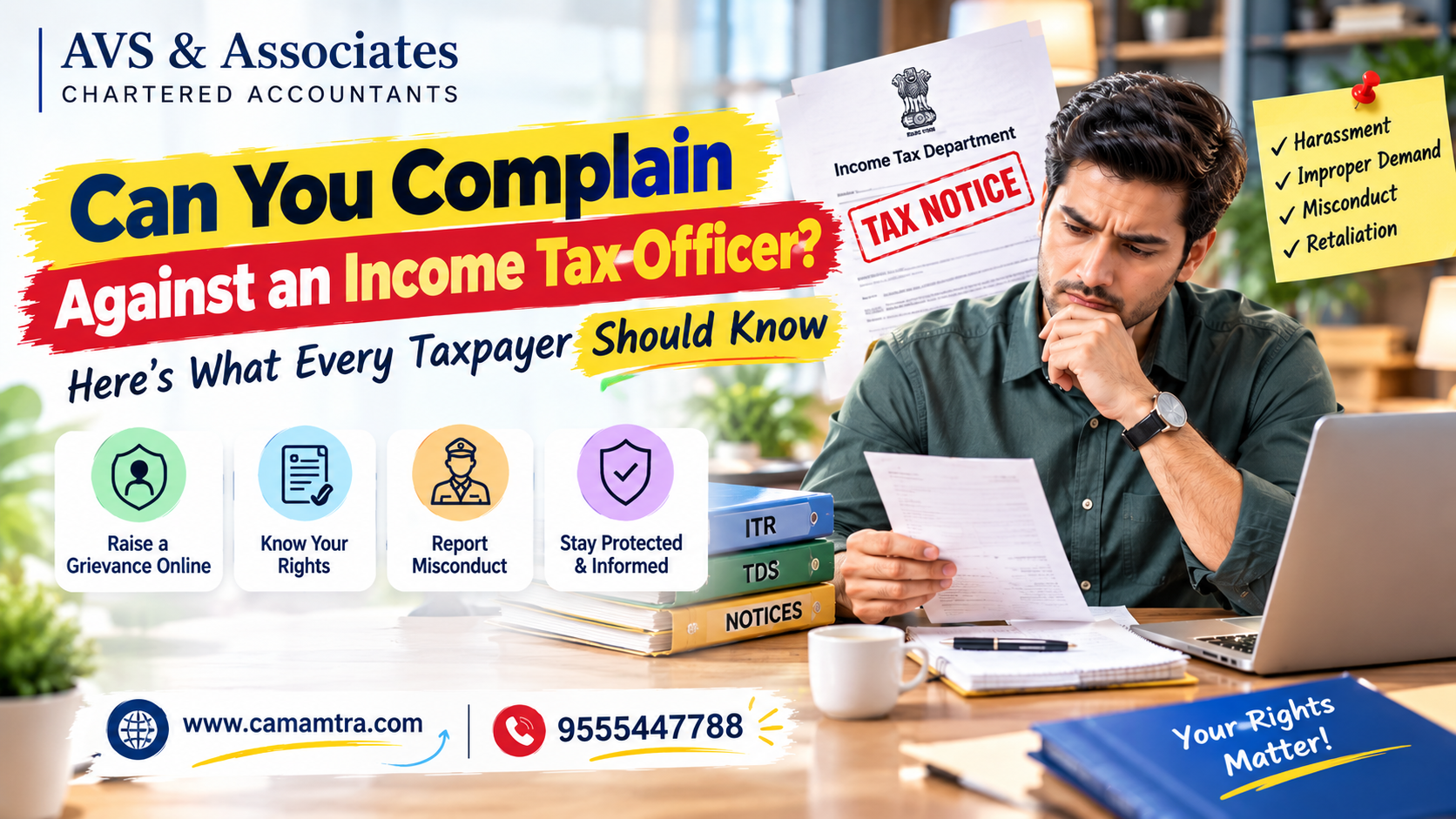
On the other hand, if you believe that you have faced inappropriate behaviour, intimidation, harassment or an improper demand, the issue may need to be addressed through an appropriate complaint or grievance mechanism.
In simple words:
Disagreeing with an officer’s tax decision ≠ misconduct.
And:
A lawful tax demand ≠ harassment.
Understanding this difference is important before deciding what action to take.
What Issues Can You Raise Through the Income Tax Grievance System?
The Income Tax Department’s grievance mechanism covers different categories of problems.
1. Return & Refund Problems
For example:
- Your return has not been processed
- Your refund is delayed
- An incorrect demand has appeared
- Rectification is pending
- You are facing an issue related to ITR-V
2. Assessing Officer-Related Issues
Certain administrative matters involving the Assessing Officer can also be raised, including issues relating to demands, refunds, rectification and appeal effects.
3. TDS Problems
Problems relating to TDS/TCS statements, challans, Form 26AS, certificates and related matters may also be raised.
4. E-Filing Problems
If you are facing technical or procedural difficulties with the e-Filing system, you can raise a grievance with the relevant department.
How Do You File an Income Tax Grievance?
The process is largely online.
Step 1 — Log in
Access the Income Tax e-Filing portal and log in.
Step 2 — Open the Grievance Section
Go to:
Grievances → Submit Grievance
Step 3 — Select the Relevant Department
Depending on your problem, you may need to select:
e-Filing | AO | CPC-ITR | CPC-TDS
Step 4 — Choose the Category
Select the category and sub-category that best describes your problem.
Step 5 — Explain the Issue
This is perhaps the most important part.
Don’t simply write:
“My refund has not come.”
Instead, explain the situation clearly:
What happened → When it happened → What documents support it → What resolution you are seeking
You may also upload supporting documents wherever applicable.
Step 6 — Save Your Acknowledgement Number
After submitting the grievance, an Acknowledgement Number is generated.
Don’t lose it.
It can be used to track the status of your grievance.
What If the Issue Is Serious?
Suppose you believe that an official has behaved improperly.
This is not something that should be handled casually.
Before making a serious complaint, create a proper record of what happened.
Keep copies of:
- Notices and orders
- Emails and letters
- Relevant screenshots
- Dates and times of interactions
- Names/designations, where known
- Documents exchanged
- Details of witnesses, if relevant
- Other supporting evidence
And most importantly:
Stick to facts.
Avoid emotional language, exaggeration or allegations that you cannot substantiate.
A strong complaint is not necessarily a long complaint.
It is a clear, factual and well-documented complaint.
What About CPGRAMS?
There is another important platform taxpayers should know about: CPGRAMS — Centralised Public Grievance Redress and Monitoring System.
It is a Government of India platform through which citizens can lodge grievances relating to public authorities.
It also provides facilities for tracking grievances and, where applicable, pursuing an appeal against the resolution.
Therefore, taxpayers should understand that they have more than one formal route available, depending on the nature of the problem.
Grievance or Appeal? Don’t Make This Mistake
This is one of the biggest points taxpayers should remember.
A grievance is NOT a substitute for a statutory appeal.
For example, suppose you receive an assessment order and believe the tax demand is legally incorrect.
Filing a grievance does not automatically replace the appeal process available under the Income-tax law.
On the other hand, if your return or refund is stuck due to an administrative issue, a grievance may be an appropriate way to seek resolution.
Here’s a simple way to look at it:
| Your Problem | Possible Route |
|---|---|
| E-Filing technical issue | E-Filing grievance |
| Refund/return processing issue | CPC-ITR / relevant grievance |
| TDS-related problem | CPC-TDS grievance |
| Administrative issue | Appropriate grievance channel |
| Disagreement with an assessment order | Appeal / legal remedy |
| Serious conduct-related complaint | Appropriate complaint/grievance mechanism |
The correct route depends on the facts of your case.
Why Does Digital Grievance Redressal Matter?
Digitalisation is usually discussed from the taxpayer’s point of view in terms of convenience.
No physical forms.
No repeated office visits.
Online notices.
Online responses.
Online refunds.
But there is another important advantage.
Digital systems can create a record of interactions.
A complaint can have:
A submission date → An acknowledgement number → A status → A resolution
This creates greater transparency and makes the process more traceable.
But the real test isn’t whether a taxpayer can click “Submit Grievance.”
The real test is whether a genuine complaint is:
Received → Recorded → Investigated → Resolved → Properly closed.
That is where accountability matters.
A Simple Rule Every Taxpayer Should Remember
Whenever you face a problem with the tax department, don’t react immediately.
First ask:
What exactly is my problem?
Is it:
A tax dispute?
An administrative issue?
A technical problem?
Or a serious complaint about conduct?
Once you identify the nature of the problem, choosing the right remedy becomes much easier.
And whatever route you choose, keep proper documentation.
Final Takeaway
Taxpayers have responsibilities — filing accurate returns, paying the correct tax and responding to lawful proceedings.
But taxpayers also have rights.
If something goes wrong during your interaction with the tax administration, you don’t have to rely only on repeated emails or personal follow-ups.
Formal grievance mechanisms exist.
The key is knowing when to use them, what to document and when a grievance is different from an appeal.
As India’s tax administration becomes increasingly digital, taxpayers should not only learn how to comply with the tax system.
They should also understand how to raise a concern when something doesn’t go as it should.
Need help understanding the right route for your tax issue?
Before filing a grievance or appeal, it is important to understand the nature of the issue and the remedy available.
At AVS & Associates, Chartered Accountants, we help taxpayers understand their tax matters, documentation and available compliance and legal remedies.
When it comes to tax, knowing your rights is just as important as knowing your responsibilities.