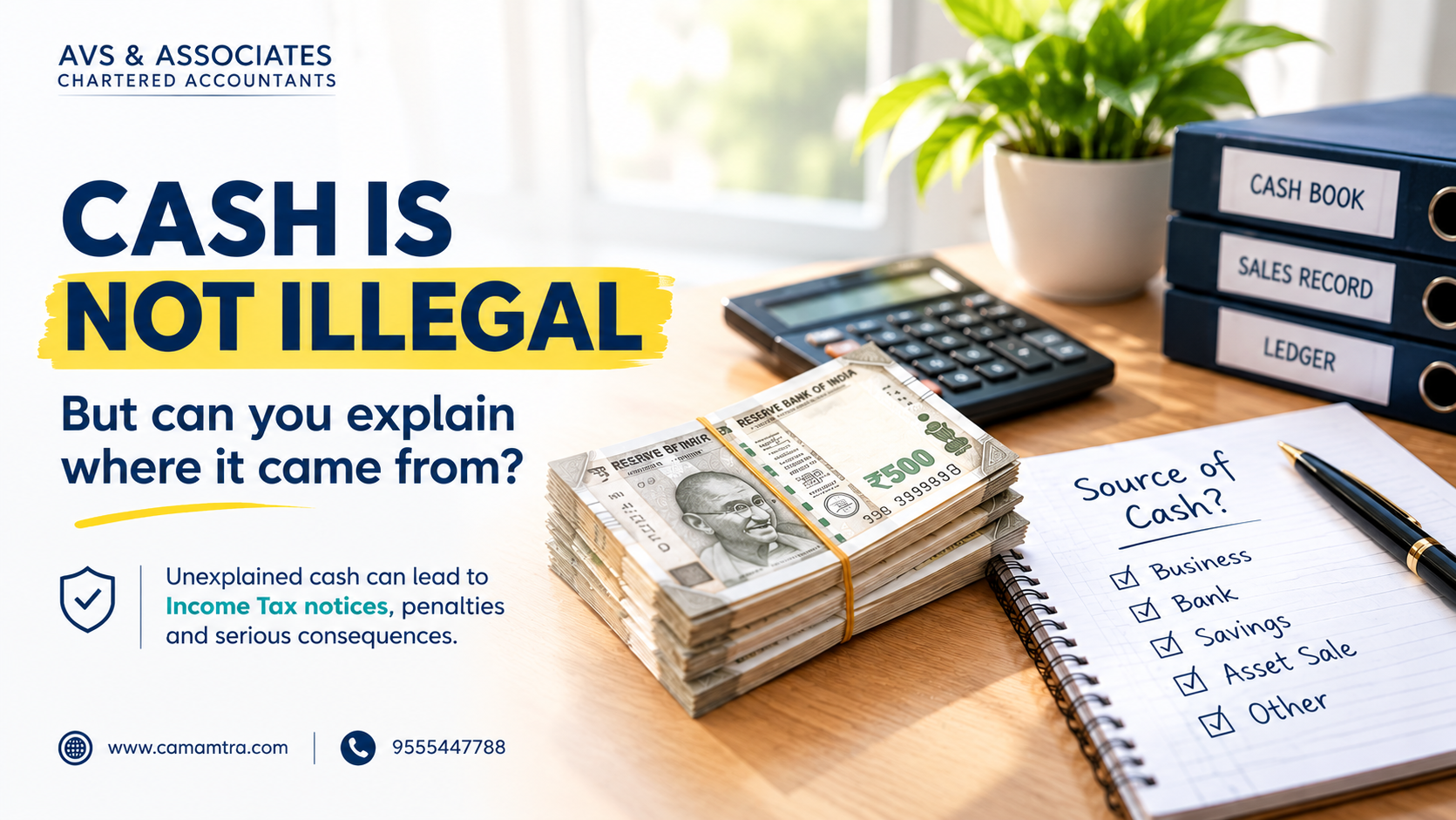
Cash is not illegal. But unexplained cash can create serious Income Tax problems.
Whether you are a business owner, professional, trader or individual, the important question is not simply how much cash you have — it is whether you can prove the source of that cash.
Is Cash Legal in India?
Yes. There is no general prohibition on holding cash.
Cash may legitimately come from:
- Business sales or professional receipts
- Bank withdrawals
- Capital introduced into a business
- Sale of an asset
- Legitimate savings
- Other disclosed and documented sources
However, when cash comes under Income Tax scrutiny, the taxpayer may need to establish its nature and source with credible evidence.
Why Is Unexplained Cash a Problem?
Imagine ₹10 lakh cash is found during an Income Tax proceeding.
Simply saying:
“This is my business cash.”
may not be enough.
The tax authorities may examine:
Cash in hand → Cash book → Sales/invoices → Ledger → Bank deposits → Tax returns → Supporting documents
If these records are consistent, the source can be explained more effectively.
If the books show ₹3 lakh cash but ₹10 lakh is actually found, the unexplained difference may require detailed justification.
Depending on the facts, provisions relating to unexplained money or income, including Section 69A of the Income-tax Act, may become relevant.
Books of Accounts Are Your First Line of Defence
For businesses maintaining books, accurate accounting records can be extremely important during tax proceedings.
Your cash book should broadly answer:
- How much cash came in?
- Where did it come from?
- When was it received?
- How was it spent?
- How much was deposited in the bank?
- What is the closing cash balance?
Regularly reconciling physical cash with the cash book can help identify discrepancies before they become tax problems.
Cash Transactions Have Tax Restrictions
While holding cash is not automatically illegal, certain cash receipts and payments are restricted under the Income-tax Act.
Important provisions include:
- Section 269ST – restrictions on receiving ₹2 lakh or more in specified circumstances
- Section 269SS – restrictions relating to certain loans and deposits
- Section 269T – restrictions relating to repayment of certain loans and deposits
- Section 40A(3) – rules concerning certain cash expenditure
Therefore, simply recording a cash transaction in your books does not automatically make the transaction compliant.
What Evidence Can Prove the Source of Cash?
The required evidence depends on where the cash came from.
For example:
Cash Sales:
Invoices + cash book + sales ledger + stock records + relevant GST records
Bank Withdrawal:
Bank statement + cash book + subsequent cash-flow records
Capital Introduction:
Capital account + supporting evidence for the source of capital
Loan/Advance:
Agreement/documentation + identity + financial capacity + transaction records, as applicable
The key is to maintain a clear and genuine audit trail.
What If You Receive an Income Tax Notice?
Don’t ignore it.
First determine:
- Which cash transaction is being questioned?
- Is it recorded in your books?
- Can the source be established?
- Does the cash balance reconcile?
- Do bank and accounting records support the explanation?
- Are any cash-transaction restrictions applicable?
A response supported by genuine documentary evidence is much stronger than a verbal explanation.
Cash Isn’t the Problem. Unexplained Cash Is.
The difference is simple:
Legitimate Cash
Source identified → Transaction recorded → Books maintained → Evidence available
Unexplained Cash
Source unclear → Books don’t reconcile → Evidence missing → Tax exposure
The Bottom Line
Cash is a legitimate form of money. But if your cash balance is ever questioned by the Income Tax Department, you should be able to explain where it came from and support that explanation with proper records.
Don’t wait for a tax notice to discover that your cash trail doesn’t make sense.
Maintain your books. Preserve your evidence. Reconcile your cash.
Need help with cash transactions, tax compliance or an Income Tax notice? Consult a qualified Chartered Accountant before responding.
Disclaimer: This article is for general informational purposes only. Tax treatment depends on the facts and circumstances of each case and the law applicable at the relevant time.
Frequently Asked Questions
Is keeping cash at home illegal in India?
No. Holding cash is not automatically illegal. However, unexplained cash can have tax consequences depending on its source and circumstances.
How do I prove the source of cash?
Use genuine supporting records such as invoices, cash books, bank statements, agreements, ledgers and other relevant documents.
Are cash sales legal in India?
Cash sales can be legitimate, but applicable Income Tax, GST, accounting and cash-transaction restrictions must be followed.
What is Section 269ST?
Section 269ST generally restricts receiving ₹2 lakh or more in specified circumstances, subject to applicable exceptions.
Can unexplained cash be taxed?
Yes. Depending on the circumstances, provisions dealing with unexplained money or income may apply.
What should I do if the Income Tax Department questions my cash balance?
Review your books, bank records and supporting documents and obtain professional advice before submitting a response.