Why Your Card Swipes Matter More Than You Think—But Probably Not for the Reasons You Imagine
Credit cards have become a normal part of everyday life.
Today, people use them for:
- Shopping
- Travel bookings
- Online subscriptions
- Dining out
- Business expenses
- International purchases
- EMI conversions
- Luxury purchases
In fact, many professionals barely use cash anymore.
And as credit card usage grows, so does a common concern:
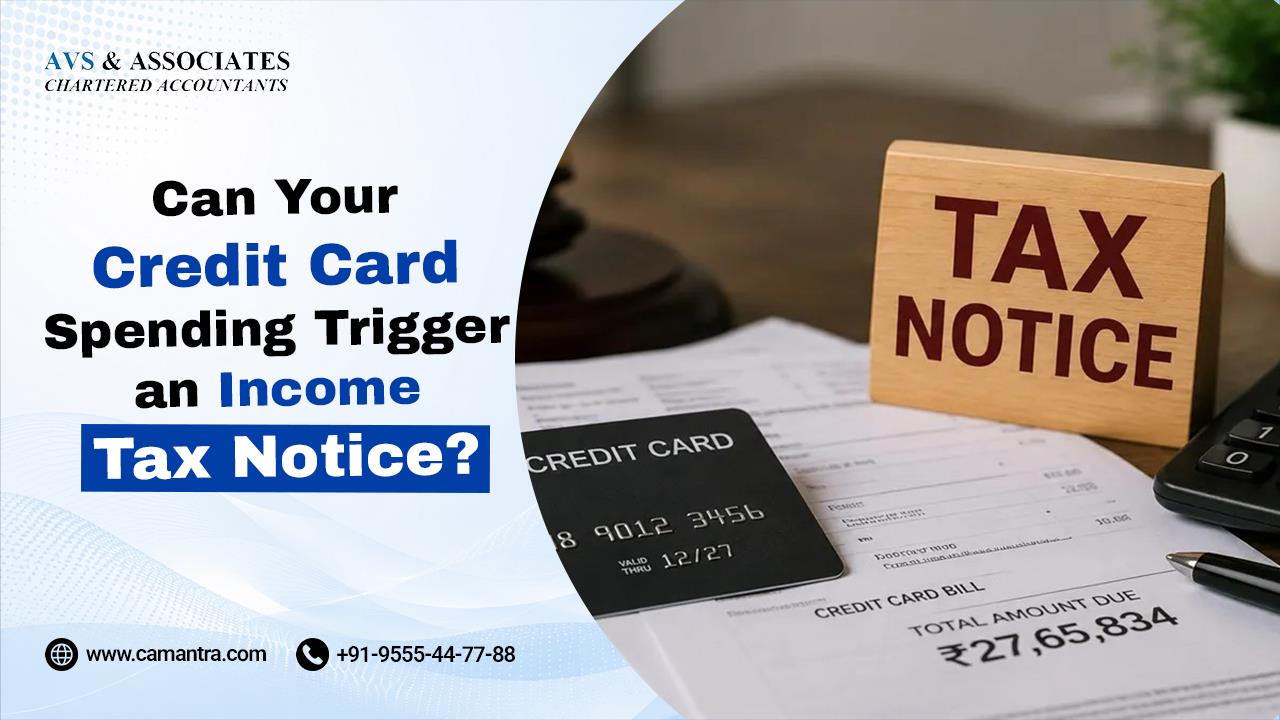
“Can my credit card spending attract the attention of the Income Tax Department?”
Some people worry that:
- Every large purchase triggers scrutiny.
- High spending automatically creates tax problems.
- Credit card usage itself is suspicious.
Others assume the opposite:
- Spending isn’t income, so it doesn’t matter.
- Credit card transactions are private.
- The tax department doesn’t care about expenditure.
The truth lies somewhere in the middle.
Let’s understand what really matters.
The Biggest Myth: Spending Is the Same as Income
Many taxpayers confuse these two concepts.
Income and spending are not the same thing.
Just because someone spends ₹10 lakh on a credit card doesn’t automatically mean they earned ₹10 lakh that year.
People spend money using:
- Salary income
- Business income
- Savings
- Investments
- Loans
- Family support
The tax department generally focuses on the source of funds—not merely the act of spending.
However, spending patterns can sometimes raise questions if they appear inconsistent with reported income.
That’s where things get interesting.
Why Credit Card Transactions Create Financial Records
Every credit card transaction leaves a digital footprint.
When you use a credit card:
- The transaction is recorded.
- The card issuer maintains records.
- Payment history is tracked.
- Annual spending can be analyzed.
This doesn’t mean every transaction is being examined individually.
But it does mean a financial record exists.
And in today’s increasingly data-driven tax environment, financial records matter.
The Real Question Isn’t “Can They See It?”
Many people ask:
“Can the Income Tax Department see my credit card spending?”
A better question is:
“Does my spending align with my reported income?”
Because that is often where potential issues arise.
Imagine someone reports relatively modest income but consistently demonstrates a much higher lifestyle through documented financial activity.
That mismatch may naturally raise questions.
High Spending Doesn’t Automatically Mean Trouble
Let’s clear up an important misconception.
Large credit card bills do not automatically create tax problems.
Many individuals legitimately spend substantial amounts because they have:
- High salaries
- Successful businesses
- Investment income
- Family wealth
- Significant savings
In such cases, spending may be entirely consistent with financial capacity.
The key issue is whether there is a reasonable explanation for the expenditure.
Lifestyle Mismatches Can Attract Attention
Modern tax administration increasingly relies on data analysis.
This means authorities may look for situations where:
Reported income and financial behavior appear inconsistent.
For example:
- Luxury purchases
- Frequent international travel
- Significant discretionary spending
- High-value transactions
By themselves, these are not problems.
But they may create questions if they don’t appear to match disclosed income sources.
Business Owners Need to Be Extra Careful
Many entrepreneurs use the same credit card for:
- Personal expenses
- Business purchases
- Travel costs
- Client meetings
Initially, this seems convenient.
But over time it creates confusion.
Questions arise such as:
- Which expenses were business-related?
- Which expenses were personal?
- Are deductions being claimed correctly?
Separating personal and business spending often simplifies both accounting and tax compliance.
International Spending Is Becoming More Visible
Today’s professionals increasingly use credit cards for:
- Foreign travel
- International subscriptions
- Overseas purchases
- Global business expenses
Cross-border transactions generate additional financial records.
This doesn’t make them problematic.
It simply means proper documentation becomes more important.
Especially for professionals with foreign income, overseas investments, or international business activities.
Credit Cards Don’t Create Tax Liability
This is another important distinction.
Using a credit card does not create income.
And it doesn’t automatically create tax.
The tax implications usually relate to:
- Where the money came from.
- Whether income was reported properly.
- Whether financial disclosures are consistent.
The card itself is simply a payment mechanism.
The Growing Importance of Financial Consistency
The modern tax environment is increasingly built around one principle:
Consistency.
The goal is not necessarily to question every transaction.
The goal is to ensure that:
- Income disclosures
- Financial records
- Investment activity
- Spending patterns
Tell a coherent story.
When they do, compliance becomes much easier.
Common Credit Card Mistakes Taxpayers Make
Some of the most frequent errors include:
- ❌ Mixing business and personal expenses
- ❌ Failing to maintain receipts
- ❌ Ignoring documentation for large purchases
- ❌ Underreporting income while maintaining a high-spending lifestyle
- ❌ Assuming digital transactions leave no trail
- ❌ Not reconciling financial records
Most tax issues arise from poor documentation rather than credit card usage itself.
Why Documentation Matters
Suppose you make a significant purchase.
Can you explain:
- How it was funded?
- Which account paid the bill?
- Whether the expense was personal or business-related?
If the answer is yes, you’re already in a stronger position than many taxpayers.
Good record-keeping creates clarity.
And clarity reduces risk.
A Practical Credit Card Compliance Checklist
Ask yourself:
- ✅ Do my spending patterns align with my reported income?
- ✅ Are large purchases properly documented?
- ✅ Have I separated business and personal expenses?
- ✅ Can I explain major transactions if required?
- ✅ Are credit card payments traceable to known sources of funds?
- ✅ Do my financial records tell a consistent story?
These simple habits can prevent unnecessary complications.
The Bigger Lesson
The debate shouldn’t be:
“Should I worry about using my credit card?”
The better question is:
“Are my finances organized and transparent?”
Because credit card spending itself is not the issue.
The issue is whether financial activity aligns with:
- Income disclosures
- Tax filings
- Available documentation
Transparency matters more than transaction volume.
Final Thought
Credit cards are one of the most convenient financial tools available today.
They help people:
- Manage cash flow
- Earn rewards
- Track expenses
- Simplify payments
But like all financial tools, they create records.
And in today’s digital economy, financial records are becoming increasingly connected.
The good news?
Most taxpayers have nothing to fear if:
- ✔ Income is reported correctly
- ✔ Spending is supported by legitimate sources
- ✔ Documentation is maintained
- ✔ Financial records remain consistent
The real risk isn’t credit card spending.
It’s the gap between what your financial records show and what your tax filings say.
And that gap is often easier to avoid than people think.
Let’s Discuss
Do you use credit cards mainly for convenience, rewards, business expenses, or cash flow management?
And do you keep separate cards for personal and business spending?
Share your experience—it may help others build better financial habits.