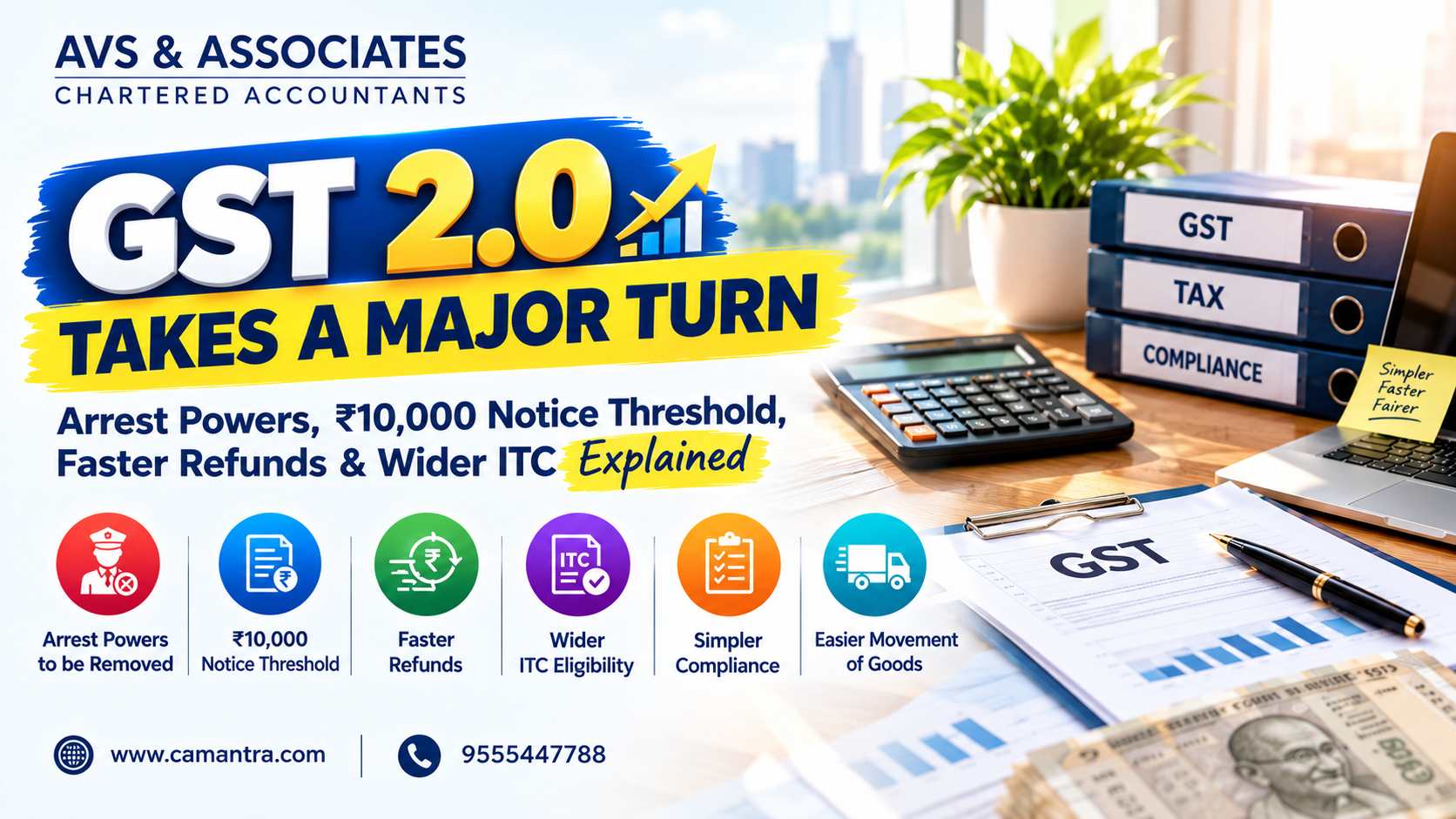
The 57th GST Council Meeting has recommended significant changes to India’s GST framework.
For years, businesses have raised concerns about GST notices, blocked working capital, ITC restrictions and lengthy compliance procedures. The latest GST Council recommendations aim to address several of these issues and make GST administration more transparent, predictable and business-friendly.
But what exactly has changed, and how will these recommendations affect your business?
Let’s understand the key takeaways from the 57th GST Council Meeting and the practical implications for businesses, exporters, manufacturers and service providers.
GST Arrest Powers Proposed to Be Removed
One of the biggest announcements from the 57th GST Council Meeting is the recommendation to withdraw arrest powers under GST.
The Council has recommended omitting Section 69 of the Central Goods and Services Tax (CGST) Act, 2017, which deals with the power to arrest under GST.
Alongside this, the Council has recommended increasing the monetary threshold for prosecution from ₹1 crore to ₹5 crore and rationalising certain offences and punishments under Section 132.
What does this mean for businesses?
If implemented as recommended, the changes could reduce the risk of criminal proceedings for certain GST-related offences and provide greater clarity regarding the circumstances in which prosecution may be initiated.
However, this does not mean that tax evasion, fake invoicing or fraudulent ITC claims will become permissible. The proposed changes are intended to rationalise enforcement while retaining action against genuine fraud and evasion.
₹10,000 Minimum Threshold Proposed for GST Show-Cause Notices
Another important recommendation is the introduction of a minimum tax-demand threshold of ₹10,000 for issuing show-cause notices under Sections 73, 74 and 74A of the CGST Act.
The proposed threshold is calculated by combining the relevant amounts of CGST, SGST, IGST and cess.
The Council has also recommended that certain pending notices and appeals involving amounts below this threshold be dealt with under the proposed provision once it comes into force.
Faster GST Refunds: Relief for Exporters and Businesses
GST refunds are an important source of working capital for exporters and businesses operating under an inverted duty structure.
Delays in receiving refunds can affect supplier payments, salaries, inventory purchases and day-to-day business operations.
To address this concern, the Council has recommended a more automated refund mechanism.
Wider Input Tax Credit (ITC): What Businesses Should Know
Input Tax Credit is one of the most important components of GST because it helps prevent cascading taxation on business purchases.
However, Section 17(5) of the CGST Act restricts ITC on specified categories of goods and services.
The GST Council has recommended rationalising these restrictions, potentially making ITC available on certain categories that are currently restricted.
The proposed changes cover categories including:
- Outdoor catering.
- Health and life insurance.
- Telecommunication towers.
- Pipelines laid outside factory premises.
- Free samples.
- Goods destroyed or written off on expiry of shelf life where destruction is required by law.
The exact eligibility will depend on the final amendments and applicable conditions.
Simplified GST Registration and Return Filing
The Council has recommended measures to make registration applications easier to complete and process, including clearer documentation requirements and a more user-friendly GST portal.
It has also recommended automatic acceptance of specified registration amendments, subject to the applicable exceptions and conditions.
On the return-filing side, proposed changes to GSTR-1, GSTR-3B, GSTR-2B and the Invoice Management System aim to improve reconciliation and reduce mismatches between reported tax liabilities and ITC.
The revised mechanism for correcting and aligning certain liabilities and ITC in GST returns has been proposed from the April 2027 return period, subject to implementation.
Easier Movement of Goods Across States
Transporters and businesses engaged in interstate movement of goods may also benefit from the proposed changes to e-way bill enforcement.
The Council has recommended that a vehicle carrying goods should generally be intercepted only on the basis of specific intelligence and with authorisation from an officer not below the rank of Joint Commissioner.
It has also recommended restricting inspections and related action in transit states, while retaining exceptions for situations such as the absence of an e-way bill or documents establishing the origin or destination of the goods.
Important GST Changes for Exporters and Service Providers
The Council has recommended changes to the Integrated Goods and Services Tax (IGST) Act that could improve the treatment of certain cross-border transactions.
The proposals include changes concerning services supplied to or through foreign branches or offices and services involving goods made physically available by overseas recipients.
These changes could help eligible Indian service providers access export-related benefits and refunds where the prescribed conditions are satisfied.
Relief for Small Taxpayers and E-Commerce Sellers
The GST Council has also recommended measures aimed at simplifying compliance for small businesses.
Optional annual return and quarterly payment scheme
The Council has approved in principle an optional Annual Return Quarterly Payment (ARQP) scheme for eligible taxpayers with aggregate turnover of up to ₹5 crore in the preceding financial year who are engaged exclusively in supplies to unregistered persons.
The proposed scheme would allow eligible businesses to file an annual return while paying tax quarterly, subject to the final framework.
Simplified registration for small e-commerce sellers
The Council has recommended a simplified registration mechanism for eligible small suppliers selling goods through e-commerce operators in states where they do not have a physical presence.
Under the proposed mechanism, an eligible seller may be able to declare the e-commerce operator’s warehouse in that state as its principal place of business, subject to specified conditions.
These measures could make it easier for smaller businesses to expand their reach without facing the same administrative burden as larger businesses.
The detailed eligibility requirements and implementation framework must be checked before relying on these facilities.
What About GST Penalties and Pending Disputes?
Apart from the proposed ₹10,000 notice threshold, the Council has recommended changes to penalties and appeal-related requirements.
These include:
- Reducing the maximum general penalty under Section 125 from ₹25,000 to ₹10,000.
- Providing a reduced penalty of 5% in eligible non-fraud cases where tax and interest are discharged within the prescribed period after adjudication.
- Removing the minimum penalty of ₹10,000 in specified non-fraud cases.
- Setting a proposed upper limit on the pre-deposit payable for certain appeals involving only a penalty and no tax demand.
These proposals are intended to make the dispute-resolution process more proportionate and reduce the financial burden in specified cases.
When Will the New GST Recommendations Become Applicable?
This is one of the most important questions for taxpayers.
The recommendations were announced at the 57th GST Council Meeting. However, a Council recommendation does not automatically mean that every change is immediately enforceable.
Certain proposed refund-related changes refer to 1 November 2026 and 1 April 2027 as prospective dates. The revised return-liability and ITC reporting mechanism has been proposed from the April 2027 return period, subject to implementation.
Taxpayers should therefore check the relevant notification and effective date before changing their tax treatment or claiming additional ITC.
Frequently Asked Questions (FAQs)
- What were the major recommendations of the 57th GST Council Meeting?
The major recommendations include removing arrest provisions under GST, increasing the prosecution threshold from ₹1 crore to ₹5 crore, introducing a proposed ₹10,000 minimum threshold for specified show-cause notices, reducing the general penalty, speeding up eligible refunds, widening ITC eligibility and simplifying registration and return compliance.
- Will GST officers no longer be able to arrest taxpayers?
The Council has recommended removing arrest powers under GST by omitting Section 69 of the CGST Act. The actual legal position must be assessed with reference to the relevant amendment and its commencement.
- What is the proposed ₹10,000 GST notice threshold?
The Council has recommended a minimum tax-demand threshold of ₹10,000, combining CGST, SGST, IGST and cess, for show-cause notices under specified sections. It is not a blanket waiver of GST dues.
- Will the GST prosecution threshold increase to ₹5 crore?
The Council has recommended increasing the monetary threshold for prosecution from ₹1 crore to ₹5 crore. The final applicability will depend on the relevant statutory amendment.
- Will businesses get faster GST refunds?
The proposed framework includes a 10-day timeline for acknowledgement or deficiency memos and provisional sanction of 90% of eligible refund claims for zero-rated supplies and inverted duty structures, subject to risk assessment and prescribed conditions.
- Can businesses claim ITC on employee insurance and outdoor catering now?
The Council has recommended removing restrictions on specified categories of ITC. Businesses should verify the final amendments, effective dates and applicable conditions before claiming such credits.
- Have GST rates changed in the 57th GST Council Meeting?
The main focus of the meeting was on procedural, compliance and enforcement reforms rather than a general GST rate revision. The official recommendations should be consulted for specific clarifications or changes relating to individual goods and services.
- Where can businesses check the official GST Council recommendations?
Businesses can refer to the official Ministry of Finance/Press Information Bureau release summarising the 57th GST Council Meeting recommendations and monitor subsequent notifications and circulars.