
Why the “Best” Tax Regime Depends More on Your Life Than on Tax Rates
Every year around tax season, the same question returns:
“Should I choose the Old Tax Regime or the New Tax Regime?”
And every year, social media fills with posts claiming:
- “The New Regime is always better.”
- “The Old Regime saves more tax.”
- “Everyone should switch.”
- “Nobody should switch.”
The truth?
None of these statements are universally correct.
Because the winner changes every year.
Not because the tax laws necessarily change.
But because your financial situation changes.
That’s what many taxpayers fail to understand.
The new tax regime is now the default option, but taxpayers can still choose the old regime if it results in a lower tax liability. The right choice depends on income levels, deductions, exemptions, and overall financial circumstances.
Let’s explore why.
The Biggest Mistake: Looking for a Permanent Winner
People often ask:
“Which regime is better?”
But that’s the wrong question.
A better question is:
“Which regime is better for me this year?”
The answer can change dramatically depending on:
- Salary increases
- Home loans
- HRA eligibility
- Investments
- Insurance premiums
- Family circumstances
- Additional income sources
The regime that saved you money last year may not be the best option this year.
Understanding the Core Difference
At a simple level:
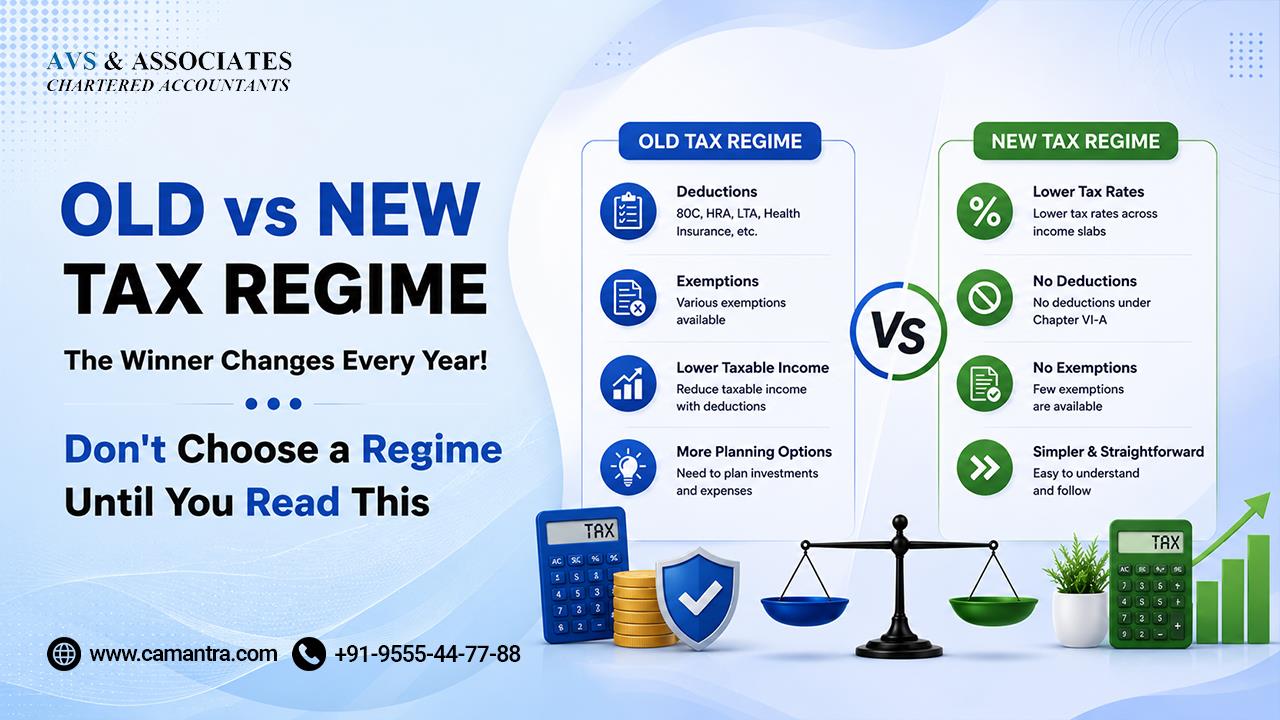
Old Tax Regime
Offers:
- Multiple deductions
- Various exemptions
- HRA benefits
- Investment-linked tax savings
New Tax Regime
Offers:
- Lower tax slab rates
- Simplified structure
- Fewer exemptions and deductions
- Reduced paperwork
The new regime generally provides lower tax rates but allows limited deductions, while the old regime permits a wider range of exemptions and deductions.
Why the New Regime Is Winning for Many Taxpayers
The government has gradually made the new regime more attractive.
Recent changes have increased the appeal of the simplified structure by offering lower rates and a higher standard deduction while reducing the need for tax-saving investments.
For many salaried individuals, especially those with limited deductions, the new regime often results in lower taxes and less compliance hassle.
This is one reason why more taxpayers are evaluating it seriously today than they did a few years ago.
But the Old Regime Isn’t Dead
Many people assume the old regime is no longer relevant.
That’s far from true.
Consider someone who has:
- Significant HRA exemption
- Home loan interest benefits
- Section 80C investments
- Health insurance deductions
- Additional eligible exemptions
For such taxpayers, the old regime can still be highly competitive.
In fact, the old regime often remains advantageous when deductions and exemptions are substantial.
The Home Loan Factor Changes Everything
Let’s imagine two employees earning the same salary.
Employee A:
- Lives in a rented house
- Has minimal investments
Employee B:
- Pays a home loan EMI
- Claims HRA or other deductions
- Maintains tax-saving investments
Same salary.
Different tax outcome.
Why?
Because deductions can significantly affect the comparison.
This is why salary alone never tells the full story.
Promotions Can Change the Answer
Many professionals choose a regime and never revisit the decision.
That’s risky.
Imagine your salary rises from:
₹12 lakh → ₹18 lakh → ₹25 lakh
As income grows:
- Tax exposure changes
- Deduction effectiveness changes
- Financial planning opportunities increase
The regime that was ideal at one income level may no longer be optimal later.
Marriage, Children and Family Responsibilities Matter Too
Life events often influence tax planning.
For example:
- Marriage
- Buying a house
- Having children
- Purchasing health insurance
- Starting investments
Each of these decisions may affect deductions and exemptions.
And that can change the regime comparison.
Tax planning isn’t static.
It’s personal.
The New Regime Is Changing Investment Behaviour
One interesting shift is happening across India.
For years, many taxpayers rushed into investments every March simply to save tax.
Today, the new regime is encouraging people to make investment decisions based on financial goals rather than tax deductions alone.
That’s a major mindset change.
Instead of asking:
“How do I save tax?”
People are increasingly asking:
“Does this investment actually make sense?”
Why Social Media Advice Often Fails
You’ll often see posts claiming:
“Choose the New Regime.”
Or:
“Always stay in the Old Regime.”
The problem?
Those recommendations are based on someone else’s situation.
Your:
- Salary
- Expenses
- Investments
- Loans
- Family structure
Are different.
Tax planning should never be based on generic advice alone.
The Smart Approach: Compare Every Year
One of the simplest tax-saving habits is:
Run a comparison annually.
Not once.
Every year.
Because:
- Income changes
- Deductions change
- Tax laws change
- Personal circumstances change
A five-minute comparison can sometimes save thousands of rupees.
Common Mistakes Taxpayers Make
Some of the most frequent errors include:
- ❌ Assuming the same regime will always be better
- ❌ Choosing based on friends’ advice
- ❌ Ignoring deductions
- ❌ Forgetting to review salary changes
- ❌ Making investments only for tax reasons
- ❌ Not comparing both options before filing
Most taxpayers don’t lose money because of tax rates.
They lose money because they don’t evaluate their options.
A Quick Decision Checklist
Ask yourself:
- ✅ Do I claim significant deductions?
- ✅ Do I have a home loan?
- ✅ Do I receive HRA benefits?
- ✅ Have my salary or finances changed this year?
- ✅ Have I compared both regimes recently?
- ✅ Am I choosing based on facts instead of assumptions?
If not, it may be time to revisit the calculation.
The Bigger Lesson
The Old vs New Tax Regime debate isn’t really about tax slabs.
It’s about:
Personal financial circumstances.
A regime that works perfectly for one taxpayer may be completely wrong for another.
There is no universal winner.
Only a personal winner.
And that winner can change every year.
Final Thought
The biggest tax mistake isn’t choosing the Old Regime.
And it isn’t choosing the New Regime.
The biggest mistake is:
Assuming the answer never changes.
Because tax planning is not a one-time decision.
It’s an annual financial review.
As your income, investments, family responsibilities, and goals evolve, the most tax-efficient choice may evolve too.
That’s why smart taxpayers don’t ask:
“Which regime is better?”
They ask:
“Which regime is better for me this year?”
And that’s often the difference between paying the right tax and paying more than necessary.
Let’s Discuss
Which regime are you currently using—Old or New?
And has your choice changed over the last few years as your income or financial goals evolved?
Share your experience. It may help others make a smarter decision this tax season.