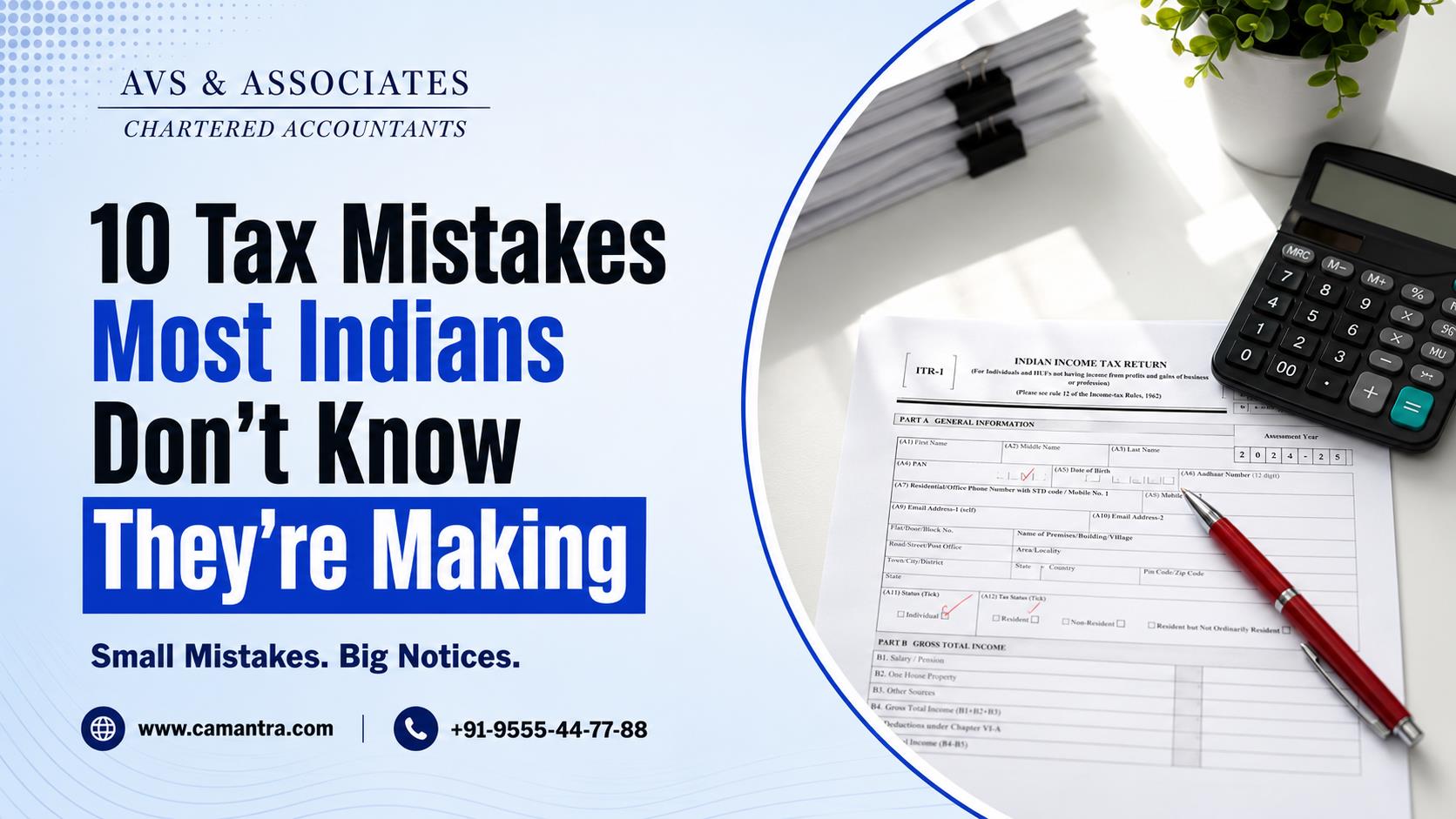
Most Tax Problems Don’t Start With Tax Evasion — They Start With Small Mistakes Nobody Notices
When people think about tax problems, they often imagine:
- Hidden income
- Tax raids
- Large penalties
- Complex investigations
But the reality is very different.
Most tax issues faced by ordinary taxpayers are not caused by deliberate tax evasion.
They’re caused by simple mistakes.
Mistakes that seem harmless.
Mistakes that happen every day.
And most importantly… mistakes people don’t even realize they’re making.
In today’s digital tax environment, where financial data is increasingly connected, even small errors can create larger problems later.
Let’s look at some of the biggest tax mistakes Indians make without realizing it.
Mistake #1: Assuming Salary Is the Only Income That Matters
Many salaried employees focus entirely on their Form 16.
They believe:
“If my salary is reported correctly, my taxes are sorted.”
But what about:
- Savings account interest?
- Fixed deposit interest?
- Freelance income?
- Rental income?
- Capital gains?
- Dividend income?
Many taxpayers forget these additional income sources entirely.
And that’s where reporting gaps begin.
Mistake #2: Never Reviewing AIS Before Filing
One of the most common errors today is filing a return without checking the Annual Information Statement (AIS).
Many taxpayers are surprised to discover that AIS may reflect:
- Interest income
- Securities transactions
- Property transactions
- Other reported financial activities
When the tax return doesn’t align with available information, questions can arise.
A few minutes spent reviewing AIS can prevent significant future headaches.
Mistake #3: Ignoring Capital Gains
People often remember to report income.
But forget to report profits from investments.
For example:
- Mutual fund redemptions
- Stock sales
- Property sales
- Digital asset transactions
Many investors incorrectly assume:
“I reinvested the money, so I don’t need to report it.”
Unfortunately, taxation doesn’t always work that way.
Ignoring capital gains remains one of the most common compliance mistakes.
Mistake #4: Mixing Personal and Business Finances
This problem is especially common among:
- Freelancers
- Consultants
- Content creators
- Small business owners
Many individuals receive business payments into personal accounts.
At first, it feels convenient.
But later they struggle to determine:
- Which payments were business income
- Which were personal transfers
- Which expenses were business-related
Good financial separation makes tax compliance dramatically easier.
Mistake #5: Believing Small Income Doesn’t Need to Be Reported
A common misconception is:
“It’s only a small amount.”
Whether it’s:
- Freelance work
- Affiliate commissions
- Side projects
- Consulting fees
Many people assume small earnings don’t matter.
But tax reporting is often about accuracy, not size.
Several small omissions can eventually become a much larger issue.
Mistake #6: Waiting Until March to Think About Taxes
Every year, millions of taxpayers suddenly become interested in tax planning during the final weeks of the financial year.
The conversation becomes:
“What can I invest in right now to save tax?”
This approach often leads to rushed decisions.
Good tax planning happens throughout the year.
Not just at the end of it.
Mistake #7: Buying Investments Only for Tax Savings
This is one of the costliest financial mistakes.
People often invest because:
“Someone said it saves tax.”
Without asking:
- Is it suitable for my goals?
- Does it fit my risk profile?
- Do I understand the investment?
Tax benefits are valuable.
But they should never be the sole reason for investing.
A poor investment doesn’t become a good investment simply because it saves tax.
Mistake #8: Not Keeping Proper Documentation
Many taxpayers underestimate the importance of records.
Then months later they start searching for:
- Investment proofs
- Property documents
- Interest certificates
- Expense records
- Payment receipts
Without documentation:
- Compliance becomes harder
- Explanations become difficult
- Errors become more likely
Good records are one of the simplest forms of tax protection.
Mistake #9: Assuming Foreign Income Is Invisible
As global work opportunities grow, more Indians now earn:
- Foreign salaries
- Freelance payments from overseas clients
- International consulting fees
- Foreign investment income
A surprising number of taxpayers assume:
“If the money comes from abroad, nobody will know.”
Cross-border reporting and financial transparency have increased significantly over the years.
Foreign income requires careful reporting and planning.
Mistake #10: Ignoring Tax Notices
This may be the most dangerous mistake of all.
Many people panic when they receive a notice.
Others do the opposite.
They ignore it completely.
Neither response helps.
Most notices are simply requests for clarification.
Responding promptly and professionally is usually the smartest approach.
Technology Has Changed Tax Compliance
A decade ago, tax compliance looked very different.
Today:
- Banking systems are digital
- Investments are digital
- Property records are digital
- Payment systems are digital
As a result, financial information is becoming increasingly connected.
The focus has shifted from manual verification to data matching.
Which means consistency matters more than ever.
The Real Problem Isn’t Tax
Interestingly, most tax issues aren’t really tax issues.
They’re record-keeping issues.
They’re planning issues.
They’re organization issues.
Many taxpayers pay the correct amount of tax but still face complications because:
- Information is incomplete
- Records are missing
- Disclosures are inconsistent
The problem often starts long before the tax return is filed.
A Simple Tax Health Check
Ask yourself:
✅ Have I reported all sources of income?
✅ Have I reviewed my AIS?
✅ Are investment gains properly tracked?
✅ Do I maintain organized records?
✅ Are personal and business finances separated?
✅ Have I planned taxes throughout the year?
If several answers are “no,” there may be opportunities to improve your compliance process.
The Bigger Lesson
Most people worry about tax rates.
Very few people worry about tax habits.
But habits often matter more.
Because taxpayers rarely face problems due to a single large mistake.
More often, problems arise from multiple small mistakes repeated over several years.
And those mistakes are usually preventable.
Final Thought
The biggest tax mistakes Indians make are often the ones they don’t realize they’re making.
Not reviewing financial records.
Not reporting all income.
Not maintaining documentation.
Not planning ahead.
The good news?
These mistakes are usually easy to fix.
A little organization.
A little awareness.
And a little proactive planning can make a significant difference.
Because successful tax planning isn’t about finding loopholes.
It’s about ensuring that your income, investments, records, and tax filings all tell the same story.
And when they do, tax compliance becomes much less stressful.
Let’s Discuss
Which tax mistake do you think is the most common in India today?
Ignoring AIS, forgetting capital gains, poor documentation, side-income reporting, or last-minute tax planning?
Share your thoughts and experiences below.