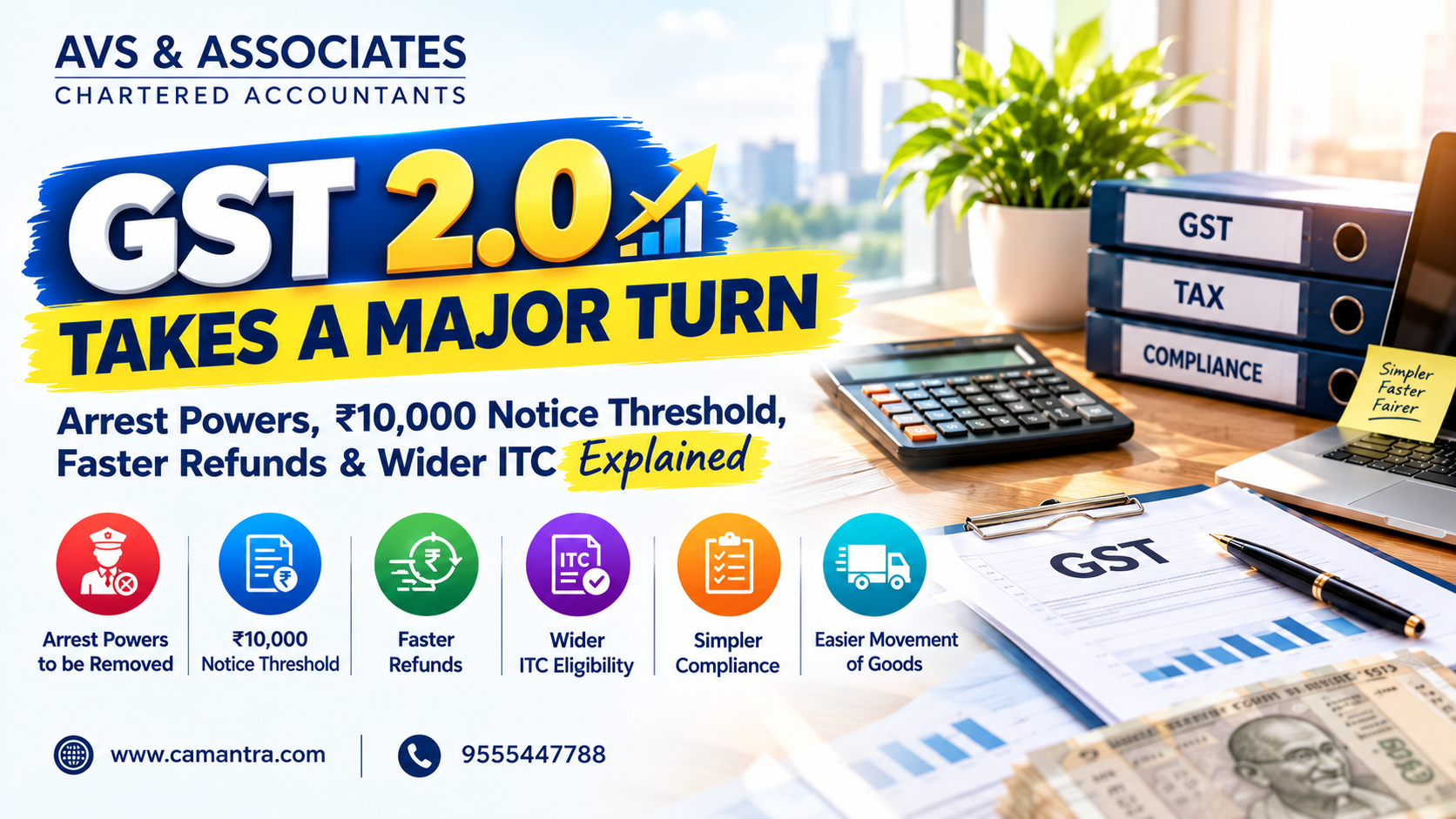
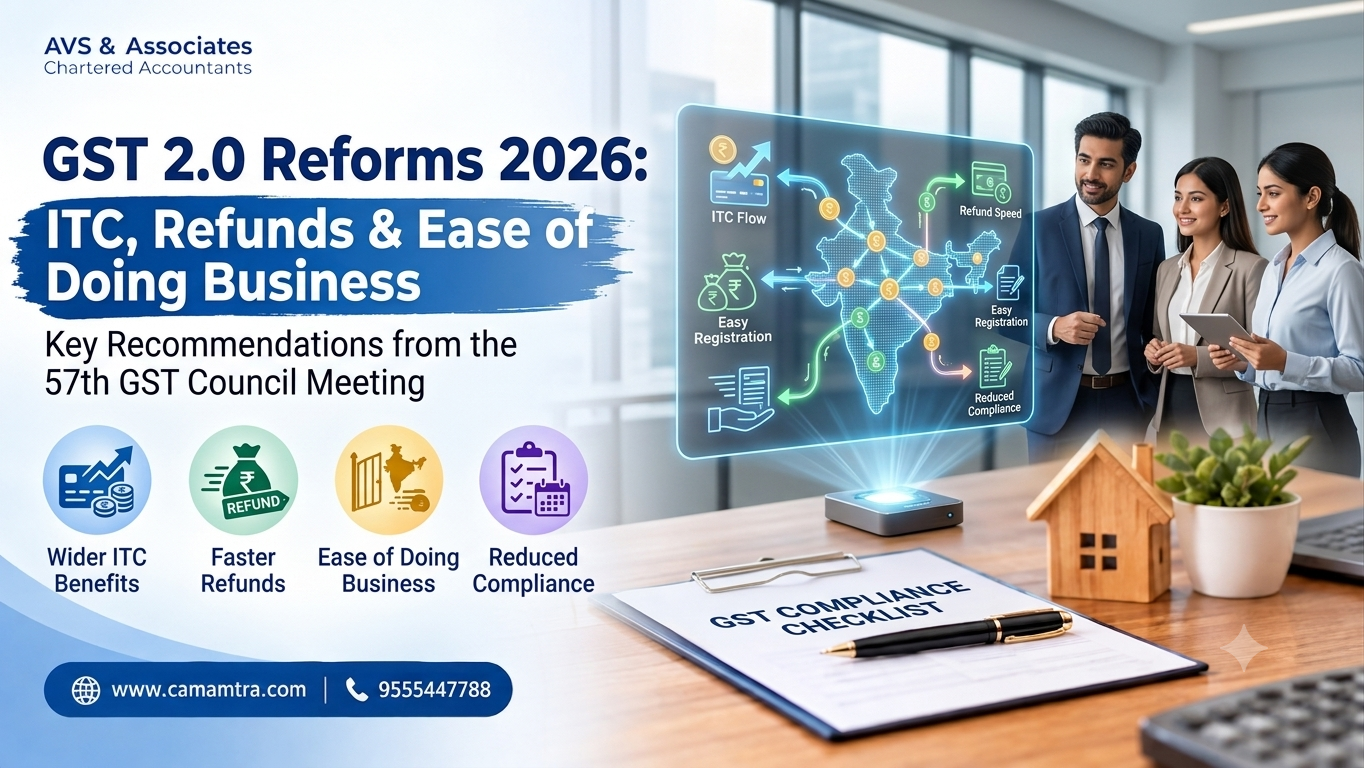
Explore the latest GST 2.0 recommendations from the 57th GST Council Meeting, including ITC reforms, faster refunds, simplified registration and reduced compliance burden for businesses.
GST Reform Is About More Than Tax Rates
When businesses think about GST reforms, the first thing that usually comes to mind is a reduction in tax rates. However, for business owners, finance teams and accountants, the real challenges often lie elsewhere — blocked Input Tax Credit (ITC), delayed refunds, complicated compliance procedures and uncertainty around tax notices.
The 57th GST Council Meeting, held on 8 October 2026, brought these operational challenges into focus. The Council recommended a series of reforms aimed at making GST compliance simpler, improving the flow of tax credits, accelerating refunds and creating a more predictable tax administration system.
The message is clear: the next phase of GST reform is not only about how much tax a business pays, but also about how efficiently it can manage its tax obligations.
Let us understand the major recommendations and what they could mean for businesses in India.
Faster GST Refunds Could Improve Business Cash Flow
For exporters and businesses operating under an inverted duty structure, accumulated GST credits can tie up a significant amount of working capital.
Even when a refund is legally available, delays in processing can affect the ability of a business to pay suppliers, manage expenses or invest in expansion.
To address this issue, the GST Council recommended greater automation in refund processing.
Key proposals include:
- System-based processing of eligible refund applications.
- Risk-based provisional sanction of up to 90% of eligible refund claims relating to zero-rated supplies and inverted duty structures.
- Reduction in the proposed acknowledgement period from 15 days to 10 days.
- Automatic processing of excess balances lying in the electronic cash ledger.
- Further automation of eligible refund claims in subsequent phases.
What does this mean for businesses?
Faster refunds could reduce the amount of money blocked in the GST system and improve liquidity. Exporters, manufacturers and businesses with accumulated tax credits may particularly benefit.
However, businesses should continue to maintain accurate records, reconcile their returns and monitor pending refund applications.
Input Tax Credit: A Major Area of Proposed Reform
Input Tax Credit remains one of the most important aspects of GST compliance. When eligible ITC cannot be claimed or utilised efficiently, the overall tax cost and working-capital requirement of a business can increase.
The GST Council recommended changes intended to widen ITC and refund eligibility in specified circumstances.
Proposed expansion of ITC benefits
The recommendations include changes relating to:
- Outdoor catering.
- Health and life insurance.
- Telecommunication towers.
- Pipelines located outside factory premises.
- Free samples and goods destroyed or written off after their shelf life expires, as specified under the proposed provisions.
The Council also recommended allowing refunds of accumulated ITC relating to certain input services and capital goods in specified inverted-duty and zero-rated supply cases, subject to applicable conditions and timelines.
For example, the recommendations provide for certain input-service ITC refunds under the inverted-duty structure for periods on or after 1 November 2026. Specified capital-goods ITC refund provisions are proposed for periods on or after 1 April 2027, with refunds relating to capital goods spread over 60 months.
These proposals could help businesses recover eligible credits that would otherwise remain blocked.
Why should businesses pay attention?
A broader ITC framework may create new opportunities, but businesses should not assume that every expense automatically qualifies for credit.
Companies should review their purchase registers, GSTR-2B, GSTR-3B, vendor compliance, supporting invoices and ITC reversals to identify eligible credits and potential risks.
The objective should be to claim every credit that is legally available while ensuring that each claim is properly supported.
GST Compliance Could Become More Digital and Predictable
GST compliance involves several interconnected processes, including invoice reporting, return filing, tax payments and ITC reconciliation.
Errors in one area can lead to mismatches, notices or unnecessary reversals elsewhere.
The GST Council recommended improvements to the return-filing and reconciliation framework, including:
- Better alignment between GSTR-1, GSTR-1A, the Invoice Furnishing Facility and GSTR-3B.
- Improved reporting of tax liabilities under the Reverse Charge Mechanism.
- Mechanisms to correct certain mismatches in reported tax liabilities and ITC.
- Improvements to the Invoice Management System.
- An electronic statement to track ITC reversals and subsequent reclaims.
Certain proposed mechanisms for correcting tax liability and ITC reporting are intended to apply from the April 2027 return period.
These changes aim to improve the accuracy of GST reporting and reduce avoidable discrepancies.
What should businesses do?
Businesses should strengthen their internal reconciliation processes rather than relying only on the final return-filing stage.
A sound GST compliance process should follow this sequence:
Purchase invoices → Accounting records → GSTR-2B reconciliation → ITC verification → GSTR-3B filing → Books reconciliation
Regular monitoring can help identify discrepancies early and reduce the risk of future disputes.
Simpler GST Registration for Eligible Businesses
Registration-related difficulties can delay business expansion, particularly for small businesses and sellers using e-commerce platforms.
The GST Council recommended improvements to registration procedures, including clearer documentation requirements, a more user-friendly GST portal and automatic acceptance of certain registration amendments.
It also recommended simplified registration arrangements for eligible small e-commerce sellers operating in states where they do not have a physical presence, subject to specified conditions.
These measures could make it easier for qualifying businesses to expand their online operations across states.
For entrepreneurs, this may mean fewer administrative obstacles. However, eligibility conditions and the applicable registration procedures must be checked before relying on these proposed facilities.
GST Enforcement and Penalties: What Is Proposed to Change?
Another important area of the 57th GST Council Meeting was the treatment of GST offences and penalties.
The Council recommended several measures intended to make enforcement more proportionate and reduce unnecessary litigation.
The key recommendations include:
- Withdrawal of specified arrest powers under GST.
- Raising the prosecution threshold from ₹1 crore to ₹5 crore.
- Reduction of the maximum general penalty under Section 125 from ₹25,000 to ₹10,000.
- A proposed minimum threshold of ₹10,000 below which show-cause notices would not be issued in the specified cases.
- More standardised procedures for notices, adjudication orders and appeals.
These recommendations should not be interpreted as permission to ignore GST obligations. Tax evasion, unsupported ITC claims and inaccurate reporting can still create serious consequences under the applicable law.
For businesses, the practical approach remains the same: maintain proper documentation, ensure timely filing and resolve discrepancies before they escalate into disputes.
Movement of Goods and E-Way Bill Compliance
Businesses involved in interstate transportation often face operational challenges relating to document verification, vehicle interception and goods detention.
The GST Council recommended changes intended to make the movement of goods smoother and more predictable.
Under the proposed framework, interception would generally be based on specific intelligence and authorisation by an officer of the prescribed rank. The recommendations also seek to clarify the jurisdiction for inspections and restrict confiscation of goods or conveyances merely while in transit, subject to specified exceptions.
These proposals could help reduce unnecessary transportation delays and improve supply-chain efficiency.
Nevertheless, businesses should ensure that invoices, e-way bills and supporting transport documents are accurate and available whenever required.
What Should Businesses Do Now?
While the proposed reforms may simplify several aspects of GST, businesses should use this opportunity to review their existing compliance systems.
Here are five practical steps to consider.
- Conduct an ITC review
Identify eligible, blocked, reversed and unutilised ITC. Review whether any newly proposed provisions could affect your business once implemented.
- Review pending GST refunds
Prepare a statement of refund amounts eligible, filed, received and pending. Identify discrepancies that may be delaying processing.
- Strengthen reconciliation procedures
Match purchase records with GSTR-2B and GSTR-3B regularly. Resolve vendor-related mismatches and incorrect classifications promptly.
- Maintain a GST notice tracker
Record the date of each notice, the relevant tax period, the issue involved, the response deadline, supporting documents and the final outcome.
- Monitor official notifications
GST Council recommendations do not automatically become enforceable law. Businesses should track the relevant notifications, circulars and statutory amendments before implementing changes in their accounting or tax processes.
The Bigger Picture: From Compliance Burden to Business Efficiency
The latest GST recommendations reflect a broader objective: making the tax system more efficient, predictable and business-friendly.
Faster refunds can help improve cash flow. Better ITC provisions can reduce the accumulation of tax credits. Simpler registration can support business expansion, while standardised procedures may reduce uncertainty in tax disputes.
However, technology and procedural simplification cannot replace sound accounting practices.
Businesses that maintain accurate records, reconcile their GST data regularly and monitor tax developments will be better positioned to benefit from these changes.
The real advantage of GST reform will not simply be a lower tax rate. It will be a system in which businesses can manage compliance more efficiently, use working capital more productively and focus more time on growth.
Conclusion
GST 2.0 represents an important step towards improving the practical functioning of India’s indirect tax system. The 57th GST Council Meeting placed significant emphasis on ITC, refunds, registration, return filing and dispute resolution.
For businesses, the opportunity lies in preparing for these changes while continuing to maintain strong compliance controls.
Simpler compliance should mean fewer avoidable errors, better cash flow and greater certainty — not less attention to tax responsibilities.
At AVS & Associates Chartered Accountants, we help businesses navigate GST compliance, ITC reconciliation, refund claims, tax notices and indirect tax advisory. Our focus goes beyond routine filings to help businesses identify tax risks, improve processes and make informed financial decisions.
Need assistance with GST compliance or an ITC review? Contact AVS & Associates Chartered Accountants for professional guidance tailored to your business.