For many tech professionals, freelancers, and consultants, income starts growing long before tax planning does.
One client becomes three.
Side projects turn into full-time consulting.
Foreign payments start arriving in USD.
And suddenly, taxes become confusing.
Questions like:
- “Do I need detailed bookkeeping?”
- “Should I maintain expense records for everything?”
- “Will I need a tax audit?”
…start showing up fast.
This is where Section 44ADA becomes important.
Because for eligible professionals, it can be one of the simplest ways to manage taxes legally and efficiently in India.
Let’s break it down in plain English.
What Is Section 44ADA?
Section 44ADA is a presumptive taxation scheme under the Indian Income Tax Act.
It was introduced to simplify taxation for certain professionals.
Instead of:
Maintaining complex books of accounts
Tracking every business expense in detail
The law allows eligible professionals to declare income on a presumptive basis.
In simple terms:
A fixed percentage of receipts can be treated as taxable profit.
Why This Matters for Tech Professionals
Today, many professionals earn independently through:
- Software consulting
- Freelance development
- UI/UX services
- IT advisory
- AI consulting
- Cloud services
- Digital strategy work
And often:
Income comes from both Indian and foreign clients.
For many of these professionals, compliance complexity becomes a bigger headache than tax itself.
Section 44ADA aims to reduce that burden.
How Does 44ADA Work?
The basic idea is simple:
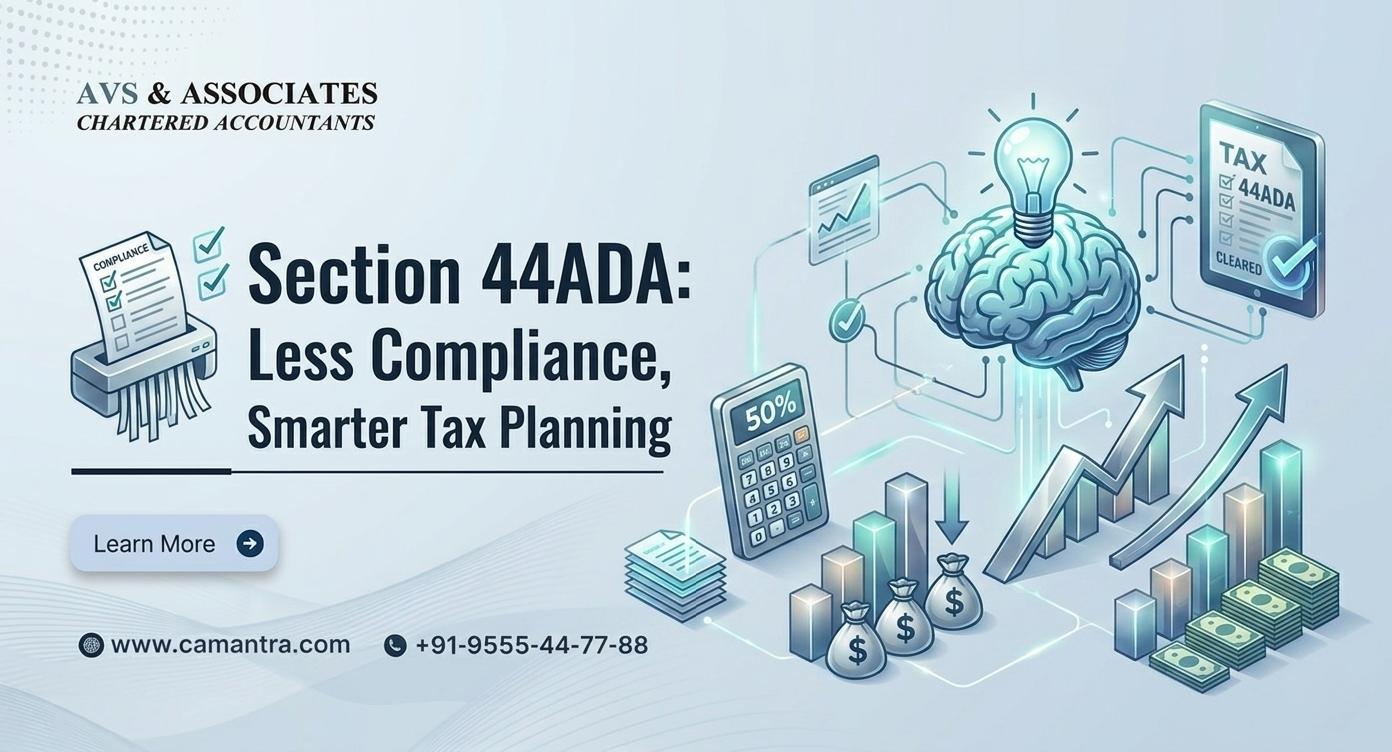
Eligible professionals can declare 50% of gross receipts as taxable income.
The remaining 50% is effectively presumed to cover expenses.
This means:
- No need to individually justify every business expense
- Reduced bookkeeping burden
- Simpler compliance process
Simple Example
Suppose your professional receipts are:
₹40 lakh annually
Under Section 44ADA:
₹20 lakh may be treated as taxable income (50%)
You generally don’t need to separately prove:
- Laptop costs
- Internet bills
- Software subscriptions
- Work-from-home expenses
The scheme assumes expenses are already accounted for within the remaining 50%.
Who Can Use Section 44ADA?
This is important.
44ADA applies to specified professionals.
Traditionally, it covered professions like:
- Legal
- Medical
- Architectural
- Engineering
- Accountancy
- Technical consultancy
And in practice, many tech consultants and independent professionals evaluate applicability carefully based on the nature of services.
The exact classification matters.
Why Freelancers and Consultants Prefer It
The biggest reason:
Simplicity.
Especially for professionals who:
- Work independently
- Have low operational complexity
- Receive digital payments
- Don’t want audit-heavy compliance
It can significantly reduce administrative stress.
What About Foreign Clients and USD Income?
A common misconception is:
“Foreign income can’t be covered under 44ADA.”
That’s not automatically true.
If you are an Indian tax resident and earning professional income from overseas clients:
The structure may still be relevant, depending on facts and compliance.
However:
- GST
- LUT requirements
- Foreign remittance documentation
…still need proper handling separately.
44ADA simplifies income taxation — not every other compliance area.
One of the Biggest Advantages: Reduced Audit Risk
Under normal business taxation:
- Lower profit declarations can trigger audit requirements in some cases.
But presumptive taxation helps simplify this for eligible professionals.
That’s one reason many consultants prefer it.
But 44ADA Is Not “No Compliance”
This is where people misunderstand the scheme.
Even under presumptive taxation, you still need:
- Proper invoicing
- Bank records
- Income reporting
- GST compliance (where applicable)
- Foreign remittance documentation
The scheme simplifies profit calculation.
It does not eliminate compliance entirely.
Common Mistakes Professionals Make
Here’s where people go wrong:
- Assuming every freelancer automatically qualifies
- Ignoring GST while using 44ADA
- Mixing personal and business expenses heavily
- Not maintaining basic documentation
- Assuming foreign income doesn’t need reporting
- Claiming lower profits without understanding consequences
These mistakes create problems later.
What If Your Actual Expenses Are Higher Than 50%?
This is an important consideration.
44ADA works best when:
Your actual expenses are relatively moderate.
But if your real business costs are significantly higher…
Then regular taxation may sometimes make more sense.
Example:
- Large employee costs
- Heavy advertising spend
- Expensive infrastructure
In such cases, presumptive taxation may not always be optimal.
Should Salaried Employees with Side Consulting Use 44ADA?
In many cases:
Professionals with freelance side income explore this option too.
Example:
- Full-time tech employee
- Plus freelance consulting or advisory work
The salary component and professional income are treated separately for tax purposes.
But eligibility and structuring should be reviewed carefully.
A Practical Checklist Before Choosing 44ADA
Ask yourself:
- Am I eligible as a specified professional?
- Is my expense structure suitable for presumptive taxation?
- Do I receive foreign payments requiring separate compliance?
- Have I separated personal and professional finances?
- Will this simplify my overall tax position?
These questions matter more than just “saving tax.”
Why 44ADA Has Become So Popular
The modern workforce has changed.
More professionals now work as:
- Independent consultants
- Remote tech experts
- Fractional advisors
- Global freelancers
Which means:
Traditional business accounting structures don’t always fit their lifestyle.
44ADA offers a simpler path for many of them.
The Bigger Lesson
Good tax planning isn’t always about complicated structures.
Sometimes:
Simplicity itself is the strategy.
And Section 44ADA is a perfect example of that.
Final Thought
For tech professionals and consultants, taxes often feel unnecessarily complicated.
But Section 44ADA can simplify things significantly for eligible individuals.
The key is understanding:
- Whether you qualify
- Whether it fits your business model
- And how it interacts with other compliance areas like GST and foreign payments
Because smart tax planning isn’t just about paying less.
It’s about:
Reducing friction while staying fully compliant.
And for many modern professionals…
That simplicity is incredibly valuable.